Centrifuges

 Do not use rotors and buckets beyond their lifetime in years or cycles.
Rotors and buckets gradually deteriorate with time, total number of uses and actual operating environment such as any damage, deformation or corrosion on the rotors and buckets. There is "Expected Lifetime of Rotors and Buckets in Years or Cycles" for safe operation.
When the rotors and buckets reach the end of their expected lifetime in years or cycles, stop their operation immediately and contact the local distributor or TOMY. The lifetime of rotors and buckets may be shortened in accordance with actual operating environment such as any damage, deformation or corrosion on the rotors and buckets. If any signs of damage, deformation or corrosion are found, stop using the rotors and buckets and contact the local distributor or TOMY.
Expected Lifetime of Rotors and Buckets in Years or Cycles >


The Rack-in-Rotor system combines a bucket shaped super lightweight rotor with a variety of drop-in racks made of resin for greater convenience and higher performance.
For details, please check High Speed Refrigerated Micro Centrifuge MDX-310 / 210 / 110
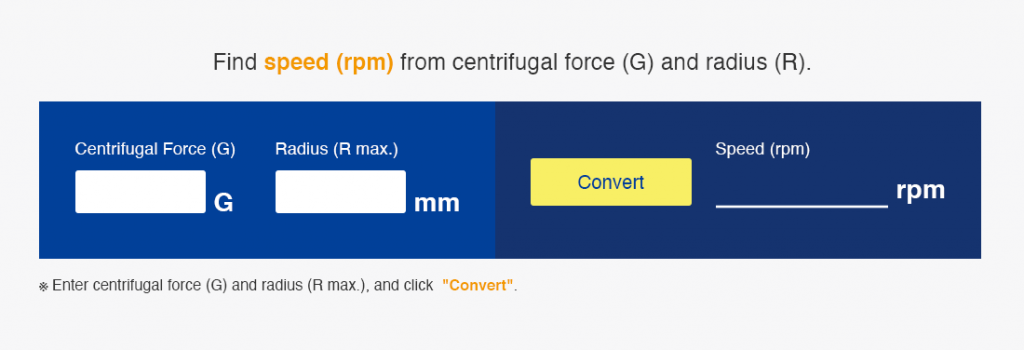
It can be converted between centrifugal force (G) and speed (rmp) with the "Centrifugal G Force Conversion App".
Please try to use it!
Rotor rotating radius is shown on the Rotor Specifications page of the operation manual that came with each model you are using.
Disconnect the power supply by turning off the power switch and unpluging the power plug.
Inspect the chamber for foreign objects such as sample pieces or broken tubes.
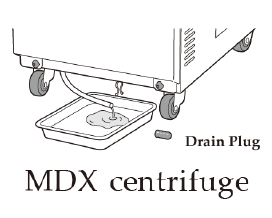
Drain the dew condensation water out from the chamber through the drain.
Clean the chamber with a soft cloth moistened with neutral detergent, and then wipe away any detergent residue using a cloth dipped in clean water and squeezed almost dry.
Be careful not to distort the sensors in the chamber during cleaning.
For details, please refer to the operation manual that came with each model you are using.